
Commonwealth Kabaddi Championship 2026: India Face Nigeria on Day 4, but the Bigger Questions Remain
कॉमनवेल्थ कबड्डी चैंपियनशिप 2026 के चौथे दिन भारत का सामना नाइजीरिया से है। भारत ने अब तक इंग्लैंड को 46-26, युगांडा को 44-30 और मलेशिया को 37-23 से हराया है, जबकि नाइजीरिया तंजानिया से 17-66 और इंग्लैंड से 18-68 से हारा है। कप्तान सुरजीत सिंह की अगुवाई में भारत तीन जीत के साथ शीर्ष पर है, लेकिन जीत का अंतर (+20, +14, +14) अपेक्षा से कम है। सबसे महत्वपूर्ण तथ्य ईरान की गैरमौजूदगी है — वैश्विक स्तर पर भारत का असली प्रतिद्वंद्वी — जिसके कारण भारत का वर्चस्व इस टूर्नामेंट में अधूरा है। निर्णायक आंकड़ा: इंग्लैंड ने नाइजीरिया के खिलाफ 68 अंक बनाए पर भारत के खिलाफ सिर्फ़ 26, जो भारतीय रक्षा की मज़बूती दिखाता है। ध्यान रखें कि कबड्डी कॉमनवेल्थ गेम्स का खेल नहीं है; यह स्वतंत्र आयोजन उस ब्रांडिंग का उपयोग करता है और इसकी प्रतिष्ठा एशियाई खेलों व विश्व कप से नीचे है। खिलाड़ी-स्तरीय आंकड़े उपलब्ध नहीं हैं, इसलिए एक रेडर पर निर्भरता का आकलन संभव नहीं।
Day 4 of the Commonwealth Kabaddi Championship 2026 is, on paper, India's easiest day of the tournament. The unbeaten Indian side, three wins from three, face Nigeria — the same Nigeria that has lost 17-66 to Tanzania and 18-68 to England. The scoreboard suggests a mismatch. But in this championship, the real question for India is not Nigeria. It is the widening gap between how India is winning and how good India is supposed to be.

India have so far beaten England 46-26, Uganda 44-30 and Malaysia 37-23. Three wins, no defeats, top of the standings. The team has been described as starting with a bang and as clear favourites. Yet a separate debate is running outside the field, and it is about mood more than numbers: India are winning, but not by the margin expected of a side of this stature. Those margins — +20, +14, +14 under captain Surjeet Singh — are comfortable, not dominant.
Why the gap compounds: the arithmetic of the All Out
Kabaddi cannot be read without its rules, because in this sport big margins are often produced not by talent alone but by rule amplification. Each raid lasts 30 seconds; the raider must chant kabaddi-kabaddi continuously and must touch a defender in the opposition half before returning safely. The defending side scores by stopping the raider for a tackle. The most decisive rule is the All Out — when all seven players of one side are ruled out, the opponent earns two bonus points and the entire team revives. That reset is kabaddi's fastest scoring engine. The do-or-die raid forces a team to attack after two consecutive empty raids, and the super tackle rewards a tackle made with three or fewer defenders on court with two points.
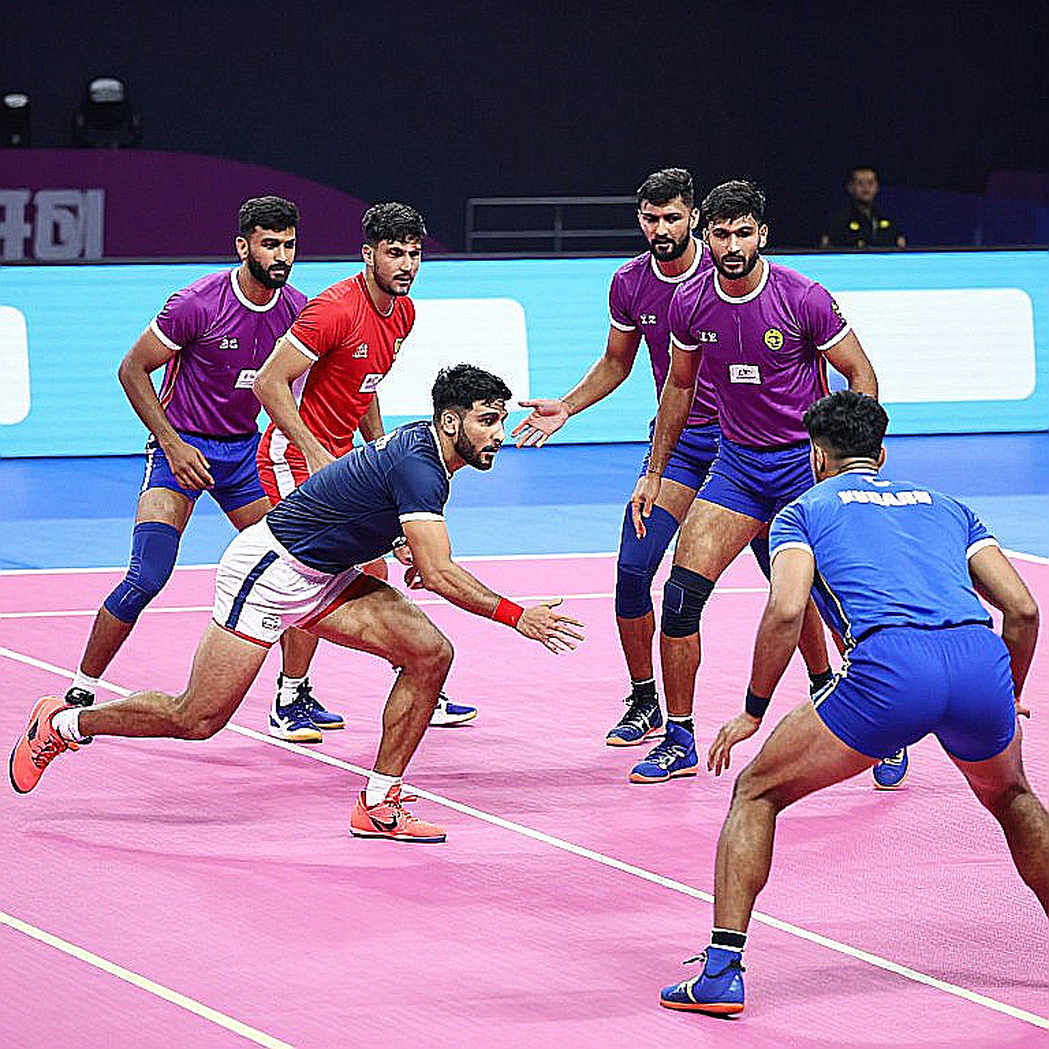
That is why Nigeria's 49-50 point losing margins are not simply the story of a weak team. Once a side loses its rhythm, the opponent forces repeated All Outs and the gap balloons. In kabaddi, blowouts are rule-amplified, not merely talent-driven. Scores of 66 and 68 therefore say something about the tournament's level — and demand caution at the same time.
India's real strength is defensive
The most important number is not in the Nigeria game but in the comparison between England's two scores. England made 68 against Nigeria and only 26 against India. India's defence cut a scoring side's output by 42 points. That is the strongest available evidence of a functioning Indian defensive unit. On the attacking side, 127 points across three matches — an average of 42 — is impressive. But India also conceded 79, between 23 and 30 per match. A genuinely dominant side would typically concede less against this level of opposition. That does not make the defence weak; it makes it good enough to win comfortably, not airtight.
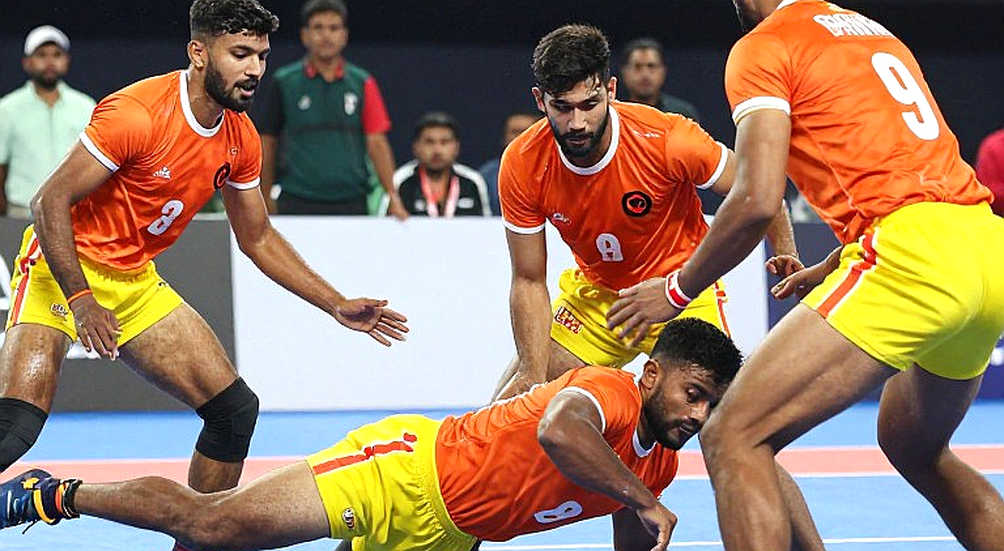
One question this report cannot answer: does India's attack depend on a single raider? The source carries no player-level raid or tackle data, only team totals. That is a data gap, not a clean bill of health. Captain Surjeet Singh is the only Indian player named, and his role — raider, defender or all-rounder — is not stated. Nor is there any information on bench depth or rotation.
Iran's absence: the biggest hidden fact
The most important structural fact about this tournament is that Iran are not in it. Global kabaddi is bipolar at the top — India and Iran — and Iran are the one nation that has genuinely beaten India at the highest level, including men's gold at the 2026 Asian Games. Without Iran, India's three wins in a row are wins over tier-2 and tier-3 opposition, and they flatter India's apparent dominance. This is not an accident but a structural outcome: an event built on Commonwealth membership excludes Iran by design.
The field shows three clear tiers: India (tier 1); England, Tanzania, Malaysia and Uganda (tier 2); and Nigeria (tier 3). The 49-50 point margins against Nigeria define the tier-3 floor. It also means that if there is a knockout or final ahead — the source does not say — India's real test will come against England, the only other side here to post a big score.
The Commonwealth label and the real status
An explanation is necessary, because the name can mislead. Kabaddi is not a Commonwealth Games sport. This championship is not part of the Commonwealth Games Federation programme; it appears to be a standalone event using the branding. Its prestige sits well below the Asian Games, the Kabaddi World Cup and the Asian Kabaddi Championship. The word Commonwealth widens the geography here — bringing in African and Southeast Asian nations — but it does not import top-tier competitive quality, because the strongest kabaddi nations, Iran and South Korea, are not Commonwealth members.
On the regional map, India's dominance comes from a rural akhada tradition and the professional ecosystem of the Pro Kabaddi League — deep roots in Haryana, Maharashtra, Punjab, Uttar Pradesh and Tamil Nadu, with the sport tied to livelihood pathways in the railways, police and army. England sit at a medium level, driven largely by the South Asian diaspora. Nigeria, Tanzania and Uganda are at a nascent stage; their presence signals outreach, not depth. This is why kabaddi's internationalisation is broad but shallow — many flags, few competitive nations.
Broadcast, sponsorship and governance opacity
Commercially, this event is very light compared with the Pro Kabaddi League. It has surfaced as a live streaming and telecast guide, meaning distribution is led by online and lower-tier channels. That points to a broadcast-rights tier below the PKL or the Asian Games. There is no data on sponsorship value, rights fees or player payments, so no conclusion can be drawn on that front. It is also worth remembering that this is not a PKL-style franchise event — no auction mechanism applies here, so auction-premium analysis has no meaning. Player compensation for national-team duty at such events is typically modest and federation-based.
The biggest institutional concern is transparency. The source does not identify the organiser, does not say which federation sanctions the event, and does not clarify the role of the International Kabaddi Federation. Kabaddi has a history of parallel federations and disputed events, so this opacity should not be treated lightly. The matches appear to be played under standard style rules, but there is no information on refereeing standards or video review. The event also does nothing to advance kabaddi's Olympic case, because its field is thin and nations such as Iran and Korea are absent.
What to watch
India's score against Nigeria will be the signal of how sharp the attack is. A total near 60 would demonstrate the ability to force repeated All Outs. But the real judgment will come against England, if that match happens. And most importantly: reading this tournament's numbers as a global ranking would be a mistake. In Iran's absence, India's dominance is real but incomplete — and that is the most honest story of this championship.